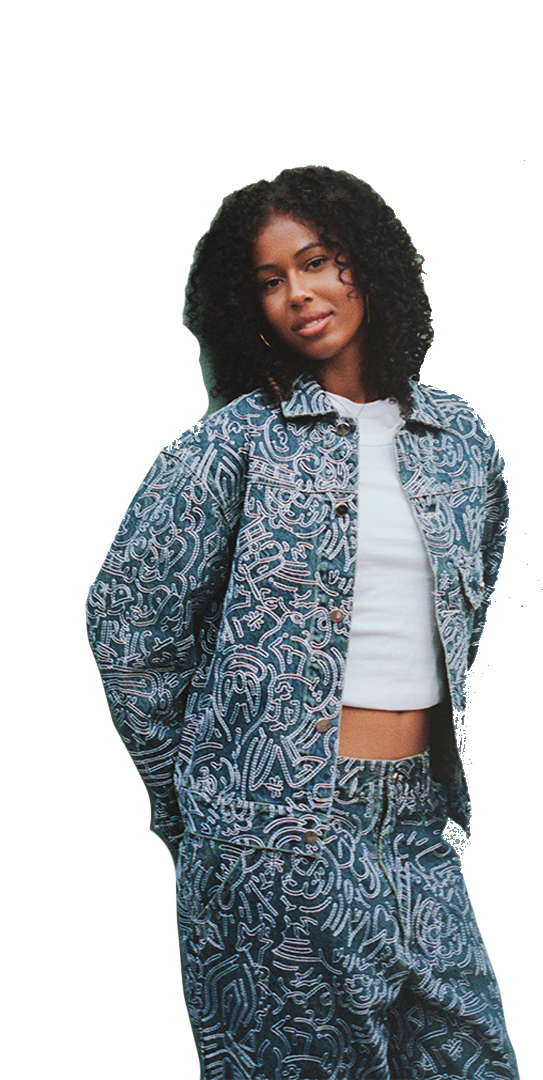
JAEL
Jael Wena speaks about music the way some people speak about inheritance, not as something she chose, but something she was born into. It was always there, waiting. Long before the industry, long before the idea of a debut single or a stage, there was a four-year-old girl standing in church, singing the first song she ever wrote, instinctively knowing that this was where she belonged.
Raised in Melbourne, Australia, Jael grew up in a household where music wasn’t extracurricular, but foundational. Her parents met playing in a church band; her mother led worship, her father played, produced and learned music by necessity and determination. “I always knew music was the thing I wanted to do,” Jael says simply. There was never a backup plan, because there was never any doubt.
That certainty didn’t come from ease. Jael’s father grew up in Congo, teaching himself piano by sneaking out at night to practise on a neighbour’s instrument while the rest of the household slept. Music was persistence, survival, faith. His journey — fleeing Congo, rebuilding his life through creativity, and eventually producing music alongside his daughter — sits at the emotional core of Jael’s artistry. “It’s a miracle how he got here,” she says. “Now we often make music together.”
With a Congolese father and an Australian mother, Jael’s early musical world was expansive. Gospel artists like Kirk Franklin, Tasha Cobbs and Tori Kelly filled the house, alongside traditional Congolese music played at family gatherings. Language, rhythm and harmony intertwined; music culture and memory. One childhood moment stands out: learning Lingala through a Congolese song her father insisted all the siblings memorise together. It was less a lesson than a bonding ritual, one that still shapes how Jael understands music as something shared.
As the eldest of four siblings, Jael grew up carrying responsibility early. “The oldest is the guinea pig,” she laughs. The one who goes first, who tests boundaries, who learns the rules before they soften for everyone else. Yet it also created closeness: younger siblings fighting to sit next to her at dinner, looking up to her as both protector and example. That dynamic – love threaded with duty – would later become a recurring emotional undercurrent in her songwriting.
It wasn’t until lockdown that Jael began to consciously shape her own musical identity. Isolation created space to listen deeply and explore jazz, R&B and soul without distraction. Aretha Franklin’s authority, Frank Sinatra’s phrasing, and the orchestral storytelling and playfulness of film composer Michael Giacchino opened new doors. “I’m very broad in what I listen to,” she says. “I listen to everything.” That openness became permission to draw from many genres to produce a unique sound.
At the centre of it all was her voice. Rich, controlled, quietly commanding, Jael’s tone carries an emotional immediacy that can’t be manufactured. Her influences reflect that gravitation toward vocal truth: Lauryn Hill’s depth, Alicia Keys’ piano-led honesty, Adele’s restraint, Jorja Smith’s tonal individuality. “I love how raw some of their music is,” Jael says. “Not too much production. Just the voice and the lyrics.”
That philosophy is most clearly heard on “Prisoner of Love,” Jael’s debut release. It’s a song that took years to arrive, but landed exactly when it needed to. Written originally in 2022, the track evolved slowly, finding new life through stripped-back performances shared online. What began as a piano-led arrangement was eventually reduced to its essence: one vocal, one guitar, no armour. The song explores love not as romance alone, but as obligation, grief, and emotional entanglement – that feeling of being bound to someone even when that bond hurts. It could be romantic partner, a friend, or relative, but ultimately, she says…“it’s about loving someone because you have to, even when it’s painful.”
She has teased the track through snippets on TikTok to such great demand, that this being her first single was a no-brainer…and obligation, “People were threatening me to put it out,” she laughs. The response affirmed what she had always believed: that intimacy, when handled honestly, travels further than spectacle.
Signing her first record deal marked a turning point – one she had visualised years earlier. “I wrote down, ‘I want to be signed in two years,’ and put it above my bed,” she says. When it happened, it felt less like arrival and more like alignment. The journey there was not smooth: moments of doubt, tears, thoughts of giving up. “But I realised this is what you have to go through,” she says. “It’s part of it.”
Despite the momentum, Jael remains intentional about how her career unfolds. She is resistant to artificial acceleration, choosing instead to build slowly and visibly – covers at the piano, acoustic performances, songs allowed to breathe before being released. “I want it to feel organic,” she says. “Not forced.” In an era shaped by algorithms and AI-generated sound, Jael’s commitment to rawness feels quietly radical.
Looking ahead, her ambitions are grounded in connection. She wants to tour intimately and expansively, and perform her original music live for the first time. She wants to continue releasing music that prioritises voice, story and emotional truth. And ultimately, she wants to give back to the family who carried her here. “One of my biggest dreams is to provide for them,” she says. “To have my dad travel with me, to be my music director.”
Jael is not rushing toward an image of who she should be. She is becoming who she already is: an artist shaped by lineage, faith and feeling, grounded in family, and guided by a voice that refuses to hide. This is not the sound of someone chasing attention. It is the sound of someone answering a calling she’s known since she was four years old.